
When your crew pulls up to a jobsite, the last thing you need is equipment that slows down installation or complicates the curing process. A UV curing system needs to be reliable, efficient, and capable of handling the range of pipe sizes contractors encounter in real-world trenchless work.
The UV XAIR system was developed with those priorities in mind. Designed for modern trenchless operations, it delivers controlled UV curing, streamlined equipment setup, and the flexibility to handle a wide range of pipe diameters without constant system changes.
At American Pipelining Solutions, equipment is selected and developed with contractors in mind. Systems are tested in real job conditions and evaluated for performance, reliability, and long-term usability before becoming part of the APS lineup. The UV XAIR system reflects that approach.
What Is UV Curing and Why Does It Matter?
In a CIPP (Cured-In-Place Pipe) installation, a resin-impregnated liner is inserted into a damaged pipeline and cured in place to create a new structural pipe within the existing host pipe.
The curing method plays a major role in installation consistency and long-term liner performance.
Traditional curing methods, such as ambient or hot-water curing, can be influenced by temperature conditions, strict mixing ratios and working times, and extended cure times. UV curing replaces those variables with a controlled process that uses ultraviolet light to activate the resin.
During installation, a UV light head travels through the installed liner at a controlled pace. As the light passes through the pipe, the resin cures and hardens, forming a strong, uniform pipe structure. Because the curing process is controlled by equipment rather than external conditions, contractors gain greater consistency and predictability during installation.
For many trenchless professionals, UV curing has become the preferred method for efficient and repeatable CIPP installations.
One System. DN 70 to DN 600. No Head Changes.
One of the first things contractors notice about the UV XAIR UV relining equipment platform is its operational range.
A single UV curing head handles pipe sizes from DN 70 ( 3 inches) up to DN 600 ( 24 inches). That range allows crews to complete a wide variety of lateral and mainline installations without swapping curing heads or reconfiguring the system between jobs.
For contractors managing both residential service laterals and larger commercial pipe rehabilitation projects, eliminating equipment changes simplifies workflow and reduces setup time.
This flexibility allows crews to handle more job types using the same system configuration, eliminating the need to purchase additional equipment to accomplish a wider range of repair.
Flash Curing Process: Speed Without Compromise
The UV XAIR system incorporates a Flash Curing Process (FCP) designed to support efficient curing speeds while maintaining consistent liner performance.
Typical curing speeds include:
- 3 in (DN 70) (4 mm wall): up to 360 feet per hour
- 4 in (DN 100) (4 mm wall): up to 328 feet per hour
- 6 in (DN 150) (4 mm wall): up to 164 feet per hour
- 9 in (DN 225) (4 mm wall): up to 98 feet per hour
- 9 in (DN 225) (5 mm wall): up to 65 feet per hour
- 12 in (DN 300) (5 mm wall): up to 42 feet per hour
\
Higher curing speeds allow contractors to complete installations more efficiently, particularly on residential and light commercial projects.
Equally important is maintaining consistent pull speed during curing. Controlled movement of the UV light head ensures uniform resin activation across the full length of the liner, helping deliver consistent structural results.
Built-In Redundancy: The Spare Kit That Keeps Your Crew Working
Every UVR XAIR ships with a complete spare parts kit that includes a spare push reel, camera head, and light head. This is not an optional add-on or an upsell. It comes standard with the system, and it is one of the most practical value-adds in the package.
On a live job, common damage events happen. Push reels take abuse. Camera heads get knocked around. Light heads operate in demanding conditions. When something goes down on a traditional system, the job stops and the crew waits. With the UVR XAIR spare kit, the crew swaps the component and keeps moving. No downtime. No pulling off the job. No lost revenue for the day.
The spare push reel adds an additional layer of protection that most contractors do not expect. It is reversible, which means a single spare reel gives your crew up to four usable ends before it is out of service. That covers the vast majority of damage scenarios a crew will ever encounter on a real job, residential or commercial.
When a component does need to go in for repair, the workflow does not stop. Your crew sends the damaged part to APS for service and continues operating with the spare in the meantime. Once the repaired component is returned, it becomes your next spare. The system is always protected, and your crew is never standing still waiting on a part to come back.
Wireless Control. Cloud-Based Documentation.
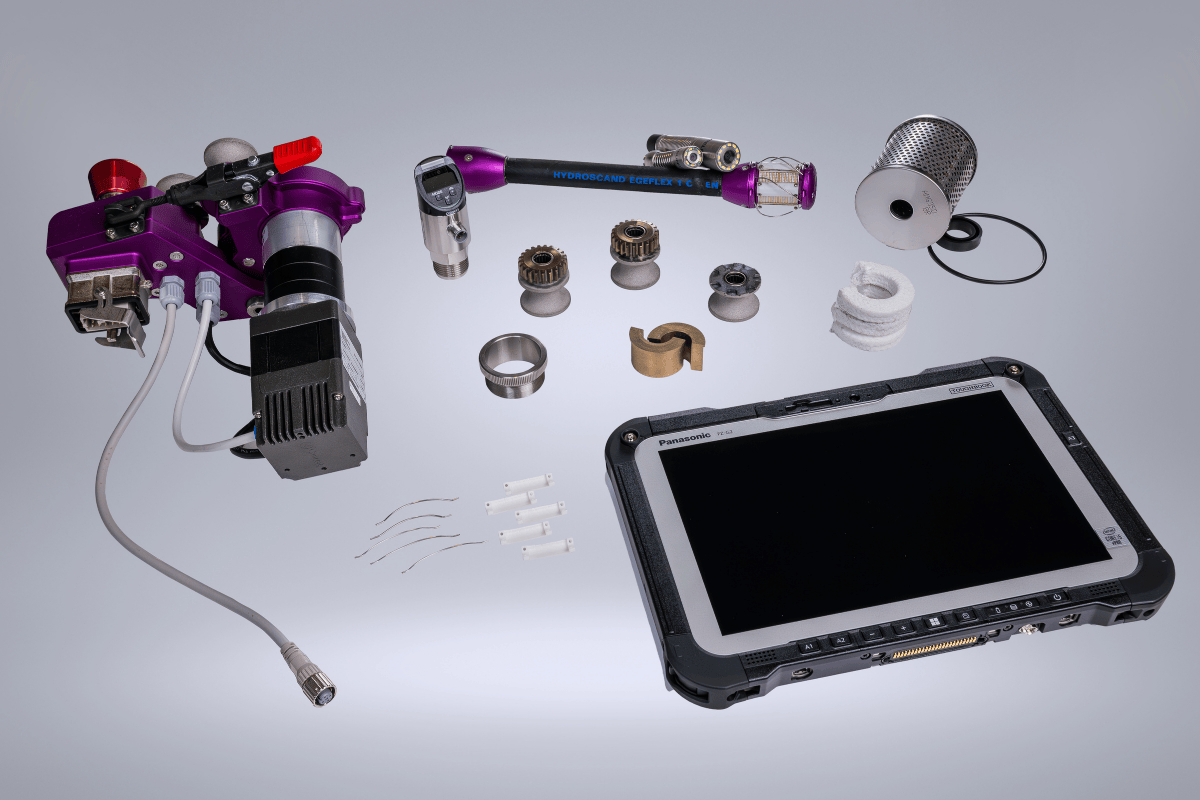
Jobsite conditions rarely allow operators to remain fixed in one location during an installation. The UV XAIR system uses a wireless control interface built on a rugged industrial tablet, allowing operators to manage the curing process remotely.
This setup provides flexibility for operators to monitor progress, adjust curing speed, and observe system performance from wherever they need to be on the jobsite.
The system also records installation data automatically. Information such as curing speed, installation time, UV output, and operational parameters are logged digitally throughout the curing process.
At the end of the installation, the system generates a clear quality report, creating documentation that contractors can provide to customers, property managers, or municipal clients when required.
This level of automated documentation supports quality assurance and simplifies project reporting.
UV Light Curing: Simplified Jobsite Setup
UV curing systems eliminate the need for boilers, steam equipment, or hot water circulation systems that are often required with thermal curing methods.
Because the UV XAIR system uses UV light to cure liners, contractors can operate with a simpler equipment setup and fewer jobsite dependencies. This approach can reduce logistical complexity while maintaining consistent curing conditions during installation.
For many contractors, the streamlined setup helps crews work more efficiently while maintaining a controlled curing environment.
T-Liner System Integration
The UV XAIR system is designed to support expanded service capabilities.
With the addition of the optional T-Liner System, contractors can perform UV-cured T-liner installations and targeted pipe repairs using the same curing platform.
This integration allows contractors to extend their trenchless service offerings without investing in an entirely separate curing system.
By supporting lateral connections, point repairs, and mainline rehabilitation, the UV XAIR platform provides flexibility for contractors growing their trenchless service capabilities.
Training and Support Through APS Training Academy (APSTA)
Introducing new equipment into daily operations requires proper training and ongoing support.
The American Pipelining Solutions Training Academy (APSTA) in Anderson, South Carolina provides hands-on certification training for contractors using the UV XAIR system and other APS trenchless technologies.
Training sessions allow crews to gain practical experience with the equipment, installation procedures, and system operation before deploying the system in the field.
In addition to training, APS provides after-sales support and in-house equipment service to help contractors maintain system performance and minimize downtime.
Ready to Add UV XAIR to Your Trenchless Operation?
The UV XAIR system is available through American Pipelining Solutions, offering contractors a UV curing platform designed for efficiency, flexibility, and consistent installation performance.
Whether your company is entering the UV curing market or expanding an existing trenchless service lineup, APS provides support with equipment setup, training, and ongoing operational guidance.
Contact the APS team to learn more about how the UV XAIR system can support your trenchless pipeline rehabilitation projects.
Frequently asked questions
Q: What pipe diameters can the UV XAIR system handle?
A: The UV XAIR system is designed to cure liners in pipes ranging from 3 inches (DN 70) up to 24 inches (DN 600) using a single UV light head. This range covers most residential service laterals as well as many commercial pipe rehabilitation applications.
Q: How fast does the UV curing process work?
A: Curing speed depends on pipe diameter and liner wall thickness. With the Flash Curing Process (FCP), the UV XAIR system can reach curing speeds of up to 360ft per hour on smaller diameter pipes, with adjusted speeds for larger diameters to maintain consistent liner curing.
Q: How is installation documented?
A: The system automatically records key installation data such as curing speed, operational parameters, and installation duration. This information can be used to generate installation reports for quality assurance and project documentation.
Q: What happens if equipment needs maintenance during a job?
A: The UV XAIR system includes field-replaceable components, allowing contractors to service key parts such as the light head or camera components without requiring full factory repair. It also comes with a spare push reel, camera head, and light head, helping crews minimize jobsite downtime. The reversible spare push reel provides up to four damage events before service is required, and crews can continue working with backup components while damaged parts are sent in for repair and returned for future use.
Q: Why choose a UV relining system for CIPP installations?
A: UV curing provides a controlled and consistent curing process, allowing contractors to complete installations efficiently while producing uniform liner results. For many trenchless operations, UV curing supports faster installation timelines and predictable project outcomes.