
When a customer calls about a cracked lateral, a leaking joint, or a section of pipe showing trench rot, contractors have a decision to make. Do you reach for a standard direct access patch kit, or do you deploy a professional pipe patching system designed specifically for trenchless repair?
At first glance, both options appear to solve the same problem. Each is intended to seal damaged pipe sections and restore functionality. However, when it comes to long-term performance, adaptability in complex pipe conditions, and overall jobsite efficiency, the difference between a basic patch kit and a professional system like Versa-Patch becomes clear.
Understanding how these solutions compare can help contractors choose the right approach for their crew, their customers, and their business.
Understanding Traditional Pipe Patch Kits
When contractors search for a pipe patch kit, they often encounter products designed primarily for accessibility and quick installation. These kits are typically sold as entry-level solutions that require minimal equipment and training.
Several common types of pipe patch kits are widely used in the industry.
Mechanical clamp-style patches are one example. These products seal damaged sections of exposed pipe by tightening a sleeve and gasket around the exterior of the pipe. They are commonly used to patch leaking pipe sections that are fully accessible above ground or inside mechanical rooms.
Fiberglass wrap kits are another option. These systems use a resin-activated wrap that is applied around the outside of a pipe to reinforce the damaged area. Some contractors rely on fiberglass systems as a temporary solution when a pipe must remain operational until a more permanent repair can be completed.
Epoxy-based repairs are also common in many pipe patch kit products designed for residential plumbing applications. Epoxy putty can seal small cracks or holes and temporarily stop leaks.
Each of these pipe patch solutions has a legitimate use case. They can be helpful for emergency repairs or situations where the exterior of the pipe is fully accessible.
However, these solutions also have limitations. Many require direct access to the outside of the pipe, which often means excavation when the pipe is underground. In addition, exterior patches typically address the surface symptom rather than rehabilitating the interior pipe structure.
As trenchless technology has grown, contractors have increasingly adopted pipe patching methods that work from inside the pipe instead.
How Professional Pipe Patching Works
Professional pipe patching systems use trenchless technology to repair damaged sections of pipe internally. This approach is commonly known as CIPP point repair, sectional pipe repair, or spot lining.
Instead of clamping or wrapping the outside of the pipe, a resin-saturated liner is inserted into the host pipe using an inflatable packer. The packer expands inside the pipe, pressing the liner against the pipe wall. Once the resin cures, the liner forms a structural repair that bonds to the interior of the existing pipe.
This method effectively creates a new pipe wall inside the damaged section without excavation.
When properly installed, a CIPP pipe patch can provide decades of service life while restoring the structural integrity of the pipe (50+ years!). This is why trenchless pipe patching has become one of the fastest-growing services in the plumbing and sewer repair industry.
For a deeper look at how the Versa Patch pipe patch kit works in the field, including packer design, lining options, and system components, explore our full overview of the Versa Patch pipe patching system.
Why Professional Systems Matter in Real-World Pipe Repairs
The packer system used during installation plays a critical role in the success of any pipe patch.
Lower-quality or entry-level pipe patch kits sometimes struggle with pressure distribution during installation. Uneven pressure can lead to wrinkles in the liner material, inconsistent bonding, or difficulty installing patches in bends or pipe transitions.
These issues are especially common when repairing pipes with:
- 45-degree bends
- 90-degree elbows
- P-traps
- diameter transitions
When a patch does not bond correctly, contractors risk callbacks, additional labor, and dissatisfied customers.
Professional systems are designed specifically to address these challenges.
How Versa-Patch Was Built for Field Conditions
The Versa-Patch system from American Pipelining Solutions was engineered to handle the conditions contractors encounter on real job sites.
Rather than focusing only on straight pipe repairs, Versa-Patch is engineered to perform reliably in bends, transitions, and tight spaces, where many pipe failures actually occur. It works seamlessly with standard equipment and does not require specialty packers, making the repair process more efficient and practical.
The Versa-Patch packer system uses a controlled inflation process that helps distribute pressure evenly across the liner during installation. This helps reduce liner wrinkles and ensures a smooth, consistent pipe patch that conforms to the interior wall of the host pipe.
The system is capable of repairing pipes with:
- 22-degree bends
- 45-degree bends
- long-radius 90-degree bends
- p-traps and short-radius elbows depending on packer size
This flexibility allows contractors to perform pipe patching in areas where many basic pipe patch kits struggle.
Versa-Patch also includes lockable hexagonal fittings that help maintain secure connections under air pressure. Elastic repositioning bands allow contractors to make small adjustments before the resin cures, which can be extremely helpful during installation in tight pipe runs.
Pipe Size and Patch Coverage
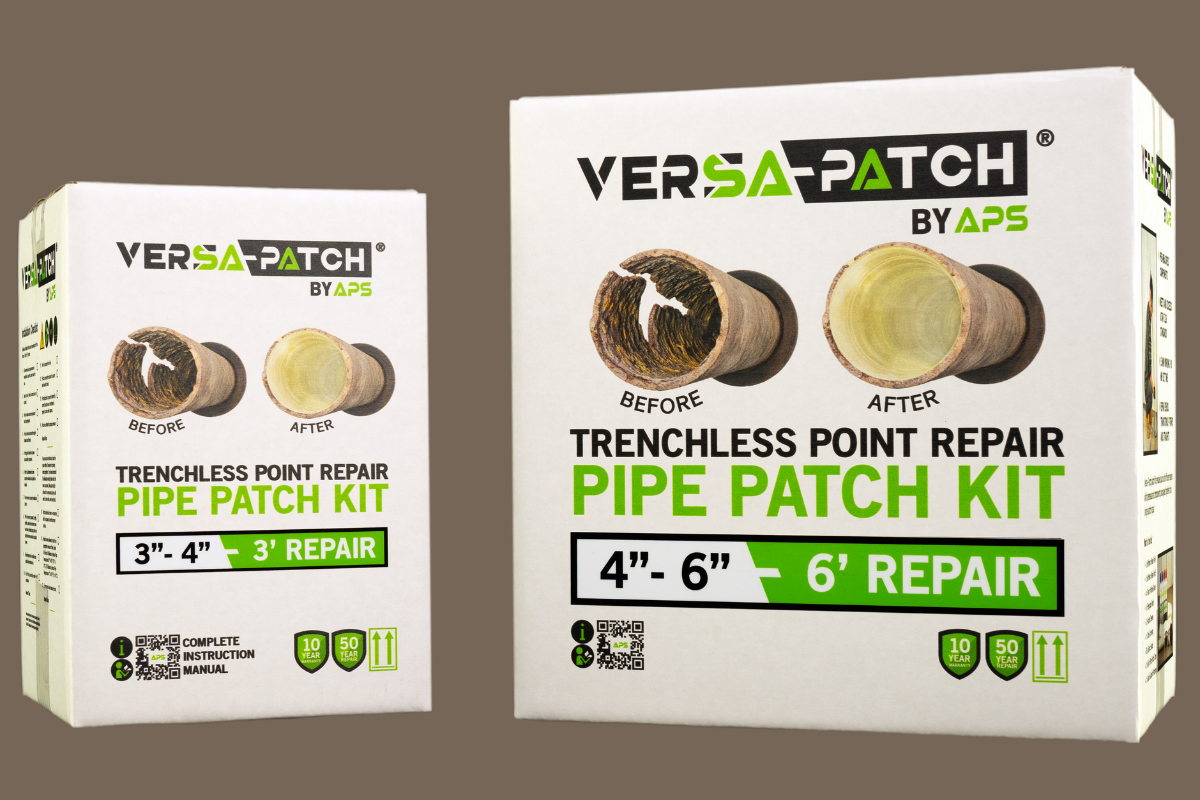
Versa-Patch systems are designed to handle a wide range of residential and light commercial repair scenarios.
The platform supports pipe patching for pipe diameters ranging from:
2-inch pipe through 6-inch pipe.
Patch lengths are available in multiple sizes, including:
- 32-inch patches
- 3-foot patches
- 6-foot patches
This coverage allows contractors to address many common sewer and drain line repairs without needing multiple specialized systems.
Material Options for Different Pipe Conditions
Another advantage of the Versa-Patch platform is the availability of multiple liner materials that meet ASTM standards, depending on the job requirements.
Versa-Glass uses fiberglass liner material that is designed for structural pipe patch repairs where rigidity and long-term durability are important.
When flexibility is crucial to the repair, APS also offers a flexible loop-stitched material designed to handle environments where the host pipe may experience movement or chemical exposure.
Having both liner options available within the same pipe patching system gives contractors greater flexibility when working with different pipe materials and service conditions.
Reusable Systems vs Disposable Pipe Patch Kits
One of the most important differences between a reusable professional system and many traditional pipe patch kits is the long-term cost structure.
Single-use pipe patch kits can appear inexpensive at first. However, when contractors are running multiple jobs each week, the repeated cost of disposable components can add up quickly.
Professional systems like Versa-Patch are designed for repeated field use. Versa-Patch packers are built for more than 100 applications when properly maintained and can be used in a wide variety of pipe configurations, rather than purchasing specialty disposable equipment.
Because the system is reusable and uses pre-measured liner and resin materials, contractors can reduce waste while improving job preparation efficiency.
For companies expanding their trenchless services, reusable pipe patching equipment often provides stronger long-term margins compared to relying on disposable patch kits.
The Growing Demand for Trenchless Pipe Patching
Customer expectations in the plumbing and sewer repair industry have changed dramatically in recent years.
Homeowners, property managers, businesses, and municipalities increasingly prefer solutions that avoid excavation and property damage. Instead of digging up yards, driveways, or floors, seriously inconveniencing homeowners and costing businesses money in lost revenue due to down time, trenchless pipe patching allows contractors to repair localized damage from inside the pipe quickly and effectively
When contractors can offer a structural pipe patch that restores the pipe without excavation, it changes the entire service conversation.
Systems like Versa-Patch allow contractors to deliver those solutions consistently while expanding their service offerings.
Why Versa-Patch Is More Than a Pipe Patch Kit
A traditional pipe patch kit is typically a single product designed for a specific type of repair.
Versa-Patch is a complete pipe patching system designed for repeated field use, versatile installation conditions, and professional trenchless applications.
Every Versa-Patch system includes:
- training options for contractors
- installation manuals and instructional materials
- technical support from APS
- certification opportunities through APSTA
The system can be operated from a service van or truck without requiring large trenchless equipment, making it accessible for contractors already offering drain cleaning or sewer inspection services.
For companies looking to add pipe patching to their service menu, Versa-Patch offers a streamlined path into the growing trenchless repair market.
The Bottom Line
Pipe patch kits have their place in plumbing and pipe repair. They can be useful for simple repairs and emergency fixes when the pipe is fully accessible.
However, professional pipe patching systems offer a much more powerful solution for underground pipe rehabilitation.
Versa-Patch provides contractors with a reusable platform designed for trenchless repairs, real-world pipe configurations, and long-term structural pipe patch performance.
For contractors who want to patch leaking pipe sections quickly, efficiently, and without excavation, Versa-Patch delivers a reliable solution that helps crews work smarter while improving profitability.
Frequently Asked Questions
Q: What is the difference between a pipe patch kit and Versa-Patch?
A: A standard pipe patch kit is typically designed for basic repairs or exterior pipe access. Versa-Patch is a professional trenchless pipe patching system that installs structural CIPP patches from inside the pipe with little to no excavation.
Q: Can Versa-Patch repair leaking pipes in bends?
A: Yes. Versa-Patch is designed to perform pipe patching in bends, including 22-degree, 45-degree, long-radius 90-degree bends, and even tight elbows and p-traps, depending on the packer selection and pipe size.
Q: How long do Versa-Patch packers last?
A: Versa-Patch packers are designed for more than 100 installations with proper maintenance. If damage occurs, APS also offers rebuilding options to extend packer lifespan.
Q: Do contractors need training to use Versa-Patch?
A: Each Versa-Patch system includes training options through APS, along with manuals, demonstration materials, and certification opportunities through APSTA. However, training is not a requirement to purchase or install Versa-Patch point repairs.
Q: Is pipe patching a profitable service for contractors?
A: Pipe patching can be a valuable addition to plumbing and sewer service offerings. By providing trenchless repairs that avoid excavation, contractors can solve localized pipe problems efficiently while expanding their revenue opportunities. Typically, installers discover a complete ROI within 2-3 jobs.