
Every trenchless job starts with the same conversation. A customer has a pipe problem. Your job is to figure out which repair method is actually right for them, and then explain it clearly enough that they say yes.
The decision between point patching, full-length CIPP pipe lining, and excavation is not always obvious, especially when you are looking at a camera screen showing a mix of conditions across a 60-foot lateral. Getting the diagnosis right is what separates contractors who build long-term customer relationships from those who over-sell, under-deliver, or recommend excavation on a pipe that could have been lined.
This guide walks through the diagnostic framework for making the right call on every job, with clear criteria for when each repair method fits and when it does not.
Why the Right Diagnosis Matters
Recommending the wrong repair method costs you in multiple ways. A point patch on a pipe that needed full-length lining leads to a callback within months. A full CIPP pipe lining job sold on a pipe that only needed a single patch creates a customer who feels oversold. An excavation recommended on a pipe that could have been rehabilitated with trenchless technology costs your customer thousands of dollars in unnecessary landscape damage or lost revenue due to downtime.
The contractor who gets the diagnosis right earns the trust of the homeowner, builds a referral-generating reputation, and runs a more profitable business because every job is scoped correctly the first time.
Camera inspection before lining is the foundation of every accurate diagnosis. What your camera reveals, and how you interpret it, determines which repair method you recommend.
What to Look for During Camera Inspection
Before any conversation about repair method, you need a thorough camera inspection of the full pipe run. Use the inspection to document the following conditions:
- Joint offsets or separations
- Root intrusion and degree of blockage
- Cracks, fractures, or holes in the pipe wall
- Sections of pipe collapse or significant deformation
- Trench rot, which is deterioration of the outer pipe surface that has worked inward
- Grease, scale, or buildup that affects pipe capacity
- Changes in pipe diameter or material along the run
- Condition of the host pipe wall overall, looking for general degradation versus isolated failures
The location, quantity, and severity of these findings determine which repair method is appropriate. No single finding automatically points to excavation. The combination of findings and the overall condition of the pipe run is what drives the recommendation.
When Point Repair Is the Right Call
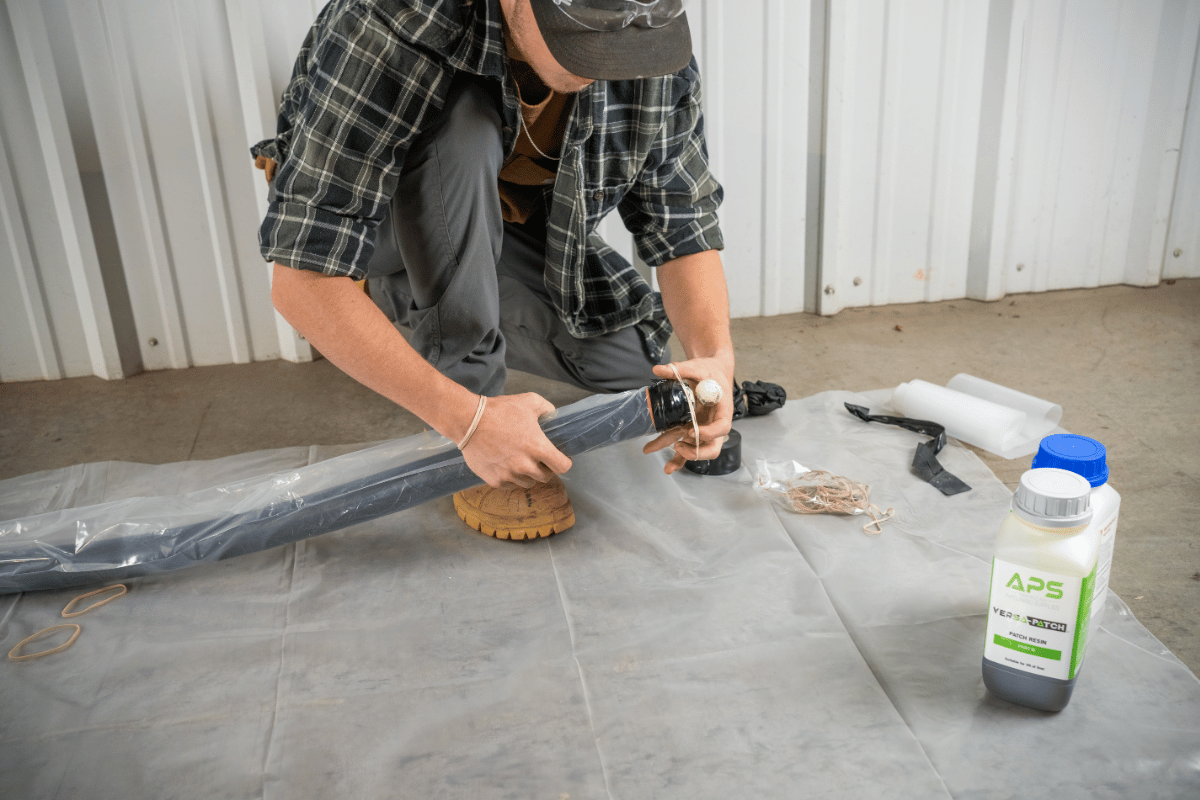
Point repair with a system like Versa-Patch by APS is the right repair method when the pipe has isolated damage at one or more specific locations, and the rest of the pipe run is in acceptable condition.
Conditions that support a point repair recommendation:
- One or two isolated cracks, holes, or joint failures in an otherwise sound pipe
- A root intrusion point that has been cleared but left a localized structural compromise
- A small section of trench rot that has not progressed along the full run
- A joint offset that has not caused surrounding pipe deterioration
- A customer who needs a targeted, cost-effective repair without full-length pipe rehabilitation
The Versa-Patch system handles pipe patching in diameters from 2 inch through 6 inch and is available with both fiberglass liner (Versa-Glass) for structural repairs and flexible loop-stitched material for patches in bends and complex geometry. Patch lengths range from 32 inches to 6 feet, which covers most isolated failure points on residential laterals.
When Full-Length CIPP Pipe Lining Is the Right Call
Full-length CIPP pipe lining rehabilitates the entire pipe run from access point to access point, creating a new pipe wall inside the existing host pipe. It is the right recommendation when the camera inspection reveals that the pipe has widespread or progressive deterioration that makes isolated patching a short-term fix at best.
Conditions that support a full-length lining recommendation:
- Multiple joint failures or cracks distributed along the pipe run
- Widespread trench rot affecting a significant portion of the pipe wall
- General pipe wall degradation that suggests the pipe is near the end of its useful service life
- Root intrusion at multiple points along the run, indicating that roots are exploiting the pipe at every available opening
- A pipe that has been repeatedly patched or serviced with no lasting result
- A homeowner who wants a long-term repair solution rather than ongoing maintenance
CIPP pipe lining using a liner and resin system from American Pipelining Solutions, delivers a 50-plus year service life when installed to ASTM standards using APSTA certified installation methods. For a homeowner facing repeated sewer problems on an aging lateral, trenchless pipe lining is typically the most cost-effective long-term answer.
Full-length lining is also the right recommendation when the alternative is excavation and replacement, because lining eliminates the landscape disruption, permit delays, and project timeline that come with digging while delivering comparable or better long-term performance.
When Excavation and Pipe Replacement Is the Right Call
Trenchless technology is not always the right answer. There are pipe conditions where excavation and replacement is the correct recommendation, and contractors who use pipe lining systems to recommend lining on every job regardless of pipe condition are doing their customers a disservice.
Conditions that support an excavation recommendation:
- Complete pipe collapse with no clear path for liner installation
- Significant pipe belly or negative grade that has caused ongoing pooling and is affecting pipe function
- A pipe run so heavily deteriorated that a liner would have no viable host pipe to bond to
- Failure caused by external factors such as a shifted foundation or ground movement that will continue to affect the repaired pipe
- Pipe systems that are shallow, short, and out of the way from day-to-day operations to limit lost revenue from downtime to businesses or disruption to a homeowner or community.
When excavation is the right call, tell your customer why clearly and honestly. A contractor who recommends excavation when it is genuinely warranted builds more trust than one who always recommends the same solution. That trust translates into referrals and repeat business.
A Quick Diagnostic Reference: Which Method Fits Which Condition
| Pipe Condition Found | Recommended Method | APS Product |
|---|---|---|
| 1 to 2 isolated cracks or joint failures | Point patch | Versa-Patch |
| Multiple distributed failures across run | Full-length CIPP lining | Houseliner |
| Structural failure, heavy deterioration | Full-length lining with structural liner | Versa-Glass |
| Pipe belly causing pooling, no flow | Excavation and replacement | Camera inspection documents |
| Full collapse, no liner path | Excavation and replacement | Camera inspection documents |
| General aging, one current failure point | Point patch now, discuss lining timeline | Versa-Patch |
How to Present the Recommendation to Your Customer
The camera inspection footage is your most powerful sales tool. When a homeowner can see the pipe condition on screen, the repair recommendation stops being an opinion and becomes an observable fact.
Walk the customer through what the camera is showing them. Point out the failure locations. Explain the difference between an isolated failure that warrants a patch and widespread deterioration that warrants full pipe lining systems. Show them what a lined pipe looks like versus an unlined pipe in similar condition.
Contractors who use their inspection camera as a diagnostic and sales tool consistently close more jobs at higher ticket values than contractors who quote from a clipboard. The camera does the selling when you know how to use it.
Building Your Trenchless Diagnostic Capability With APS
The trenchless repair decision starts before the liner goes in. It starts with the camera, the assessment, and the technician who knows how to read both.
APS offers training across the full trenchless workflow at the APS Training Academy, including camera inspection technique, pipe condition assessment, and how to match repair method to pipe condition. Our after-sales support team is available when you run into a situation where you need a second set of eyes on the diagnosis.
Whether you are running your first trenchless job or scaling a crew that handles dozens of CIPP pipe lining installs per month, APS has the equipment, materials, and training to support accurate diagnosis and high-quality repairs on every job.
Reach us at (888) 258-9359 or at sales@pipeliningsuppliesusa.com to talk through your current equipment setup or to get into the next APSTA training session.